
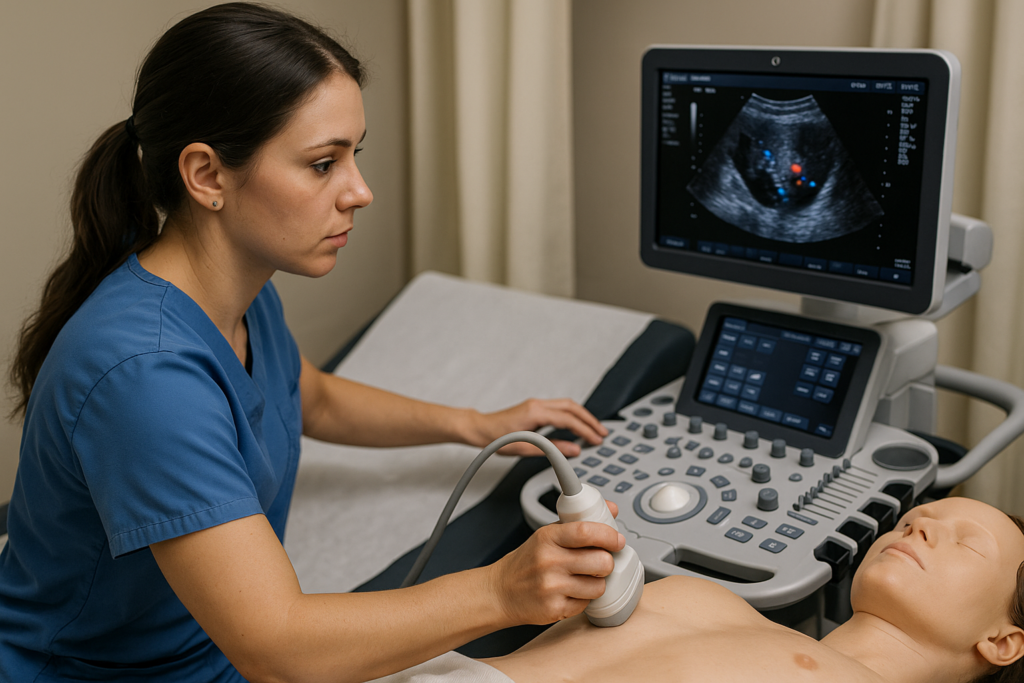
Clear images begin long before a transducer touches the skin. Room setup, patient positioning, machine presets, and careful labeling make the difference between a guess and a study a provider can use. Ultrasound Technology training puts those pieces together. You learn physics you can apply, hand skills you can repeat, and patient communication that keeps exams calm even when answers matter.
What Ultrasound Technology Teaches First
Start with foundation. Anatomy in cross section so a two dimensional image maps to three dimensional structures. Physics that you actually use at the console: frequency, depth, gain, focus, and artifacts. Early labs keep the scope tight. Find the gallbladder in two views. Track the common carotid and jugular. Measure the kidney without clipping the cortex. By repeating simple targets, Ultrasound Technology builds the muscle memory you will lean on in live exams.
From 2D to Doppler: Making Flow Readable
Structure is only half the story. Flow tells the rest. You will practice color settings so aliasing does not mask direction, then use pulsed waves for localized velocities and continuous waves when speeds run high. Angle correction, sample volume placement, and scale choices matter. In vascular labs you calculate resistive indices and measure intima media thickness. In abdominal or obstetric practice, you balance frame rate with resolution so motion stays crisp. Ultrasound Technology teaches you to choose settings with intent, then document in a sequence the reader expects.
Patient Communication That Lowers Anxiety
Most people arrive curious or worried. Scripts help, but tone matters more. One sentence upfront about what you will do and how long it usually takes. A heads up before pressure over a tender space. For transvaginal or other sensitive exams, a plain explanation and a pause for consent. Offer small comforts: a blanket, a slower turn into left lateral decubitus, a moment to breathe. Calm language and steady hands make exams feel shorter and safer.
Clinical Rotations Where Timing Sets In
Class makes concepts clear; clinic sets pace. You will see add ons, rooms that turn quickly, and cases that need extra patience. General exams one hour, limited studies thirty minutes, urgent checks squeezed between. Preceptors look for steadiness more than speed at first. Can you meet protocol, label cleanly, communicate kindly, and finish on time without cutting corners. Speed follows once your sequence is solid.
Tools You Will Use
Expect cart based systems and portable machines, convex and linear transducers, and specialty probes where indicated. You will route images to PACS, match them to the correct order, and verify they appear in the reading queue. When a machine misbehaves, you reset safely, document the hiccup, and notify the right person. Technology should help the scan, not become the scan.
Where Ultrasound Technology Leads
Graduates step into hospital imaging departments, outpatient clinics, and specialty practices in areas like OB, vascular, and general abdominal work. Early roles center on routine protocols. With experience and site specific training, many move into high risk obstetrics, advanced vascular, pediatrics, or leadership as lead techs and preceptors. The base remains steady: complete studies that other clinicians can read quickly and trust.
Training That Becomes Trust
Good imaging looks effortless because the process is tight. Ultrasound Technology brings that process into reach with practical physics, repeatable probe work, and documentation that holds up. If you want the exact course sequence, lab time, and clinical flow, start with the Ultrasound Technology program at Eastwick College. It lays out how training becomes reliable studies and steady patient care.