
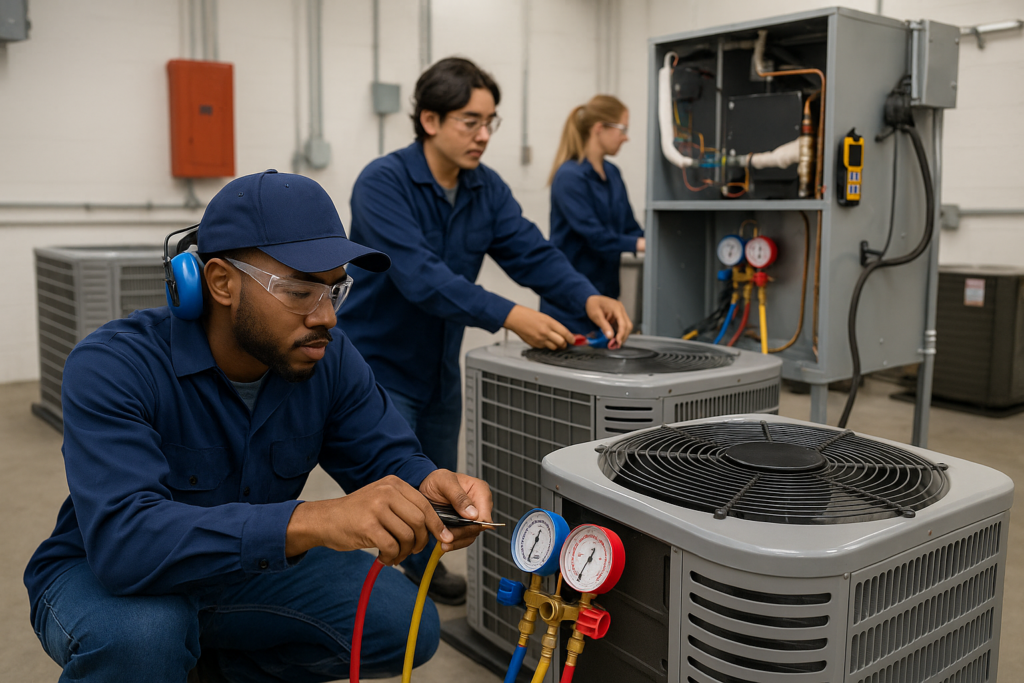
Most buildings feel comfortable because someone set the system up right, fixed it fast, and kept it efficient. The training is practical. You learn how equipment breathes, where energy leaks, and how to get a unit back online under pressure. The payoff shows up early on actual service calls.
What Heating, Ventilation, Air Conditioning, and Refrigeration Technology Teaches First
Safety sets the pace: lockout and tagout meter use without guessing, proper PPE and handling of refrigerants with respect for regulations. From there, basics stack up: temperature, pressure, superheat, subcooling. You’ll practice copper work, flaring, brazing, leak checks, and clean electrical terminations. The early goal is simple. Read the numbers, make a small change, confirm the result.
Hands-On Labs That Feel Like Job Sites
Experience real units on stands, not just diagrams. You’ll wire low voltage controls, trace 24-volt circuits, and verify compressor starts. You’ll recover the refrigerant correctly, pull a deep vacuum, and verify that it holds. Airflow labs cover filter resistance, blower settings, static pressure, and proper duct sealing. Each lab ends the same way: document what you did, why you did it, and the result. That habit shortens future calls.
Reading the System, Not Just the Part
A failing capacitor looks obvious. So does a dirty coil. But Heating, Ventilation, Air Conditioning, and Refrigeration Technology training pushes you to step back. If the same motor keeps failing, airflow is low. If pressures drift, is the charge right or is the metering device stuck? You learn to rank causes and test the fastest, safest one first. Less part-swapping. More repairs that last.
Controls You Can Trust
Most problems trace to controls. You’ll learn to read a simple schematic without getting lost, isolate a bad safety switch, and use a multimeter to check voltage drop and continuity. Thermostats, relays, contactors, defrost boards, economizers. You practice clean, labeled wiring and tidy junctions so the next tech can follow your work. Neat wiring reduces callbacks. Inspectors notice.
Airflow and Comfort Basics
Comfort is air moved at the right temperature, quietly and without drafts. Labs cover duct sizing concepts, register placement, and sealing techniques that real crews use. You’ll set blower speeds, confirm CFM with a straightforward method, and understand how small restrictions stack up. On service, this turns into simple wins: quieter rooms, better balance and fewer hot spots.
Refrigeration Skills That Travel
Walk-in coolers and ice machines share logic with comfort cooling. You’ll learn recovery procedures, sight-glass reading, receiver function, and expansion device behavior. You’ll set superheat with confidence and verify subcooling without second-guessing the gauge. Heating, Ventilation, Air Conditioning, and Refrigeration Technology makes the cold side familiar so you can step into kitchens, stores, and medical spaces with less ramp time.
Installations That Pass the First Inspection
Good installs look boring. Level pad. Plumb set. Cleared clearances. Linesets supported and insulated. Condensation trapped and pitched right. Electrical properly sized and labeled. You’ll practice brazing with nitrogen, pulling a vacuum to spec, weighing in charge, and completing a clean start-up sheet. The result is simple. Fewer leaks. Fewer callbacks. Faster final payment for the crew.
Tools You’ll Actually Use
Analog and digital gauges. Vacuum pumps with micron gauges. Recovery machines, scales, and core pullers. Clamp meters, manometers, leak detectors, flaring tools, and tubing benders. You’ll learn which tools to use in each circumstance and how to stage a truck so you can reach anything in sixty seconds. Tools save time only when you can grab them without thinking.
Where the Training Leads
Entry roles include installer’s helper, maintenance tech, or junior service tech across residential, light commercial, and refrigeration. With experience and site credentials, you move into lead installer, service specialist, or controls-focused roles. Some add building automation. Others focus on energy audits or retrofits. The base is the same: safe work, clean measurements, thorough notes.
Start a Career in HVAC
Good comfort feels invisible. That’s the goal. Systems that start right, breathe well, and run efficiently through summer and winter. If you want a clear next step that shows the classes, the labs, and the field prep, check out the Heating, Ventilation, Air Conditioning, and Refrigeration Technology Program at Eastwick College. It outlines how the training turns into safe installs, faster diagnostics, and steady work.