
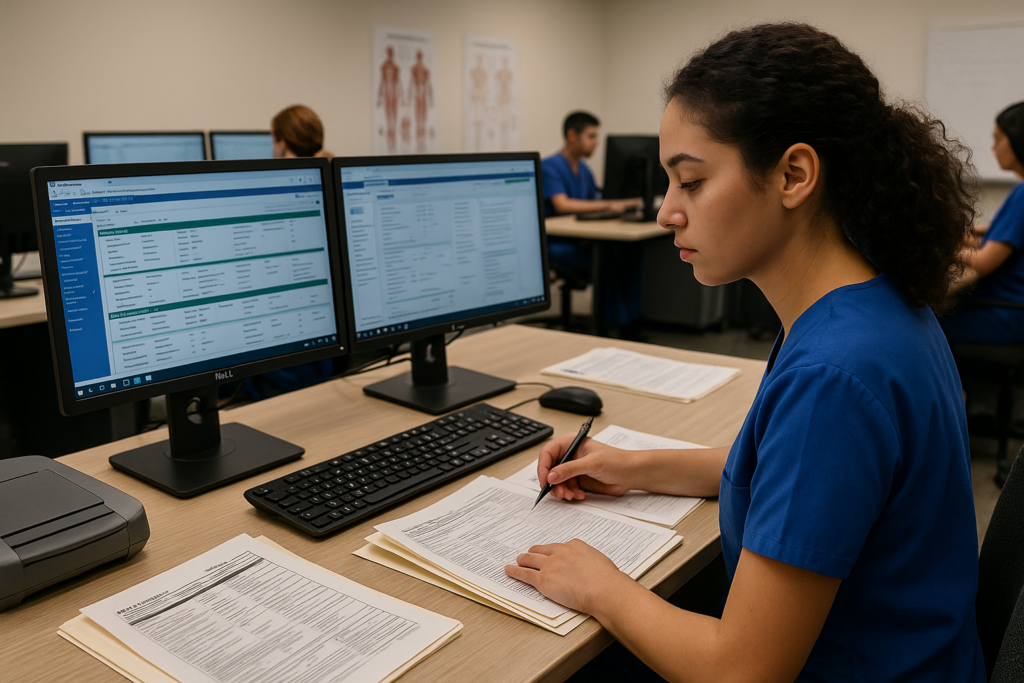
Hospitals run on information–appointments, lab values, imaging notes, billing codes, signatures. When that information is clean, care moves. When it is messy, delays ripple across the day. Health Information Technology gives you the skill set to keep records accurate, privacy protected, and data useful. You learn how charts are built, how systems talk to each other, and how to spot small errors before they become big problems.
What Health Information Technology Covers First
Health Information Technology starts with foundations. Medical terminology so you can read a chart without guessing. Record structure for inpatient and outpatient settings. Privacy rules and why access is role based. Early labs teach you to review a chart, verify identifiers, and update fields without breaking the audit trail. You practice coding basics, understand how data flows between systems, and build habits that make audits smooth instead of stressful.
From Paper Trails to EHR Workflows
Most records now live in an electronic health record, but paper still shows up. You learn to digitize documents cleanly, index them to the right patient, and reconcile duplicates. In the EHR, you follow a single visit from intake through discharge and see where errors usually appear. Wrong date of birth. Missing physician signature. Procedure code that does not match the note. Health Information Technology teaches you to flag and fix these issues with a simple, traceable process.
Coding and Data Quality Without the Jargon
Coding looks complex from the outside. In practice, it is pattern matching with rules. You learn the logic behind common diagnosis and procedure codes, practice with short case examples, and confirm that codes align with documentation. The goal is to create work that is clear and defendable. Health Information Technology trains you to document why a code was selected, what supporting text exists, and where a chart needs a clarification request.
Privacy, Security, and Why They Matter
Privacy is not a checkbox. It is a daily discipline. You apply the principle of minimum necessary access, log out when you step away, and keep discussions out of public spaces. You will also learn basic security hygiene: unique passwords, phishing awareness, and how to recognize when an access request is out of scope. Health Information Technology ties these habits to real consequences, like denied claims or corrective action, so the rules stick.
Hands-On Labs That Match Real Work
Expect labs with mock charts, realistic errors, and time limits. You will process chart completions, resolve missing signatures, and route queries to clinicians. You will run simple reports that pull patients by diagnosis or date range and then validate that the results are complete. Short drills build speed without sacrificing accuracy. You learn to work steadily, not frantically, which is what teams need on a busy Monday morning.
Interoperability and the Basics of Data Exchange
Healthcare uses multiple systems that must share information. You are introduced to standards that let data move between them and the practical steps for catching mismatches. Patient name variations. Two people with the same address and birthday. A lab result that arrives before a visit appears in the schedule. Health Information Technology shows you how to resolve these safely so downstream teams see a single, correct chart.
Tools You’ll Use and Why
You will use EHR platforms, coding tools, and reporting dashboards. You will work with document scanners, secure email, and ticketing systems for requests. The aim is not to master every feature. It is to know which screen answers which question, how to export a clean list, and how to track your changes so another person can follow your work. Clear notes save time for the entire team.
Where Health Information Technology Leads
Graduates step into roles such as health information technician, medical records specialist, release of information clerk, or coding support. With experience, you can move into data quality, privacy coordination, cancer registry support, or revenue cycle roles. The common thread is accuracy under time pressure. Health Information Technology prepares you to deliver that across settings.
Starting a Career In Health Information Technology
Health Information Technology keeps patient records accurate and current so care teams can focus on patients instead of chasing paperwork. You learn the mix of coding, privacy, data flow, and steady process that makes a hospital or clinic run smoothly.. If you want to see how these skills are taught step by step, start with the Health Information Technology Program at Eastwick College It